

Sustainable Building Stewardship: Fifty Years of Better Questions

The Long Game | Forest & Stewardship Series
How the language of sustainability transformed the built environment, and what it demands of us now

There is a pattern hiding in plain sight across the last five decades of environmental and social progress. Every ten years or so, a new word enters the mainstream, a concept that begins with genuine practitioners, earns credibility through hard work, and then gets co-opted, diluted, and turned into a marketing vehicle by the very forces it was meant to challenge.
This is not a story of failure. It is something more nuanced, and ultimately more demanding. The ideas behind each word transferred anyway, even when the word itself was hollowed out. The awareness became real. And real awareness, once embedded in a generation of practitioners, has a way of cutting in directions no one anticipated.
We taught the world to ask better questions. Now we have to live with the answers.
The Arc: A Vocabulary of Consciousness
Trace the timeline from 1970 onward and the pattern becomes unmistakable. Earth Day 1970 marks the beginning, the first moment environmental awareness entered mainstream public life in North America. What followed was a sequence of keywords, each one capturing the emerging consensus of its decade. Each one was born in genuine practice, adopted by the mainstream, co-opted by marketing,…and yet, each one left the underlying knowledge intact.
1970s — Recycle
Earth Day 1970 launches the modern environmental movement. Curbside recycling programs follow within the decade. Within years, “recyclable packaging” becomes a selling point regardless of whether anything is actually recycled. The word is hijacked almost immediately. But the idea it carried, that waste is a design failure, not an inevitability, survives.
1980s – Sustainable
The United Nations’ Brundtland Commission coins the defining phrase in 1987: “meeting the needs of the present without compromising the ability of future generations.” It enters public consciousness and never really leaves. By 1999, every major corporation has a sustainability report. The word absorbs everything and starts to mean almost nothing. But the principle underneath it, that extraction has limits, and those limits are real and measurable, proves far more durable than the word itself.
1990s – Stewardship
The language shifts from concern to obligation. Stewardship implies active care,…not just good intentions. International environmental management standards (ISO 14001) spread across industries. Corporate environmental responsibility matures as a framework. Measurement is still largely voluntary and self-reported, which means it is still largely unreliable. But the expectation that stewardship should be demonstrated, not merely claimed, is now part of the professional conversation.
2000s – LEED & Built Green
The US Green Building Council launches LEED, Leadership in Energy and Environmental Design in 2000. For the first time, independent third-party verification enters the mainstream of the building industry. A building can no longer simply claim to be green. It has to prove it. This is the inflection point.
The green building industry is born, and immediately attracts those seeking the certification without the commitment. But something irreversible has also happened: a generation of building professionals has been trained to ask what a claim actually means, how it is measured, and who verified it.
2010s–2020s – WELL Building Standard
The conversation shifts from planet to people. The WELL Building Standard, launched in 2014, brings indoor air quality, natural light, biophilic design (connecting people to nature inside buildings), and occupant health into the professional mainstream. COVID-19 accelerates public awareness dramatically. The built environment is now understood as a direct determinant of human health,… not merely an aesthetic or economic question.
“The greenwashing of every word was the price of admission to mainstream awareness. The awareness itself was real.”
The Double-Edged Sword: Transparency Cuts Both Ways
Here is where the story becomes complicated, and important. The tools that sustainability professionals built to measure and verify performance were fundamentally tools of transparency. Third-party audits. Life-cycle assessments. Disclosure frameworks. Certification standards. Each one asked the same basic question: does the evidence match the claim?
And transparency, once introduced into a system, cannot be selectively applied.
LEED trained a generation of building professionals to ask: what does this claim actually mean? How is it measured? Who verified it? Those are straightforward questions until you apply them consistently. Because when you turn that same lens on resource supply claims, on corporate reporting, on institutional behaviour, the answers are frequently uncomfortable.
Consider the forest industry. For decades, timber supply projections built on regrowth assumptions from the 1960s, 70s, 80s, and 90s have come up short. In plain terms: the forests were cut faster than they grew back, and the models that said otherwise were too optimistic. Climate change has compounded the problem. Altering soil ecosystems, increasing the frequency and severity of fire, drought, and pest pressure have taken a poorly understood toll. The projections were not necessarily dishonest when they were made. But the honest reckoning,…real numbers, not hope,…has been slow to arrive in public discourse.
Wood is one of the finest building materials available. Context matters enormously. But building with wood in regions increasingly prone to extreme heat events requires clear-eyed accounting of what the supply chain actually contains, and what it will contain in twenty years. The same discipline that LEED brought to building performance belongs in the conversation about resource supply. Stewardship means exactly that: active care grounded in accurate information, not comfortable assumptions.
The Environmental, Social, and Governance (ESG) investment movement offers a parallel story at a different scale. What began as a genuine framework for holding corporations accountable, measuring not just profit, but impact on people and planet, became, within a decade, one of the most contested and misused labels in financial markets. A 2022 study by InfluenceMap found that the majority of equity funds marketing themselves as ESG-aligned were actually misaligned with the Paris Agreement goals they claimed to support. Same word. Different reality.
In cleaning the lens, we found that the gap between aspiration and accountability was wider than most institutions wanted to admit. That is not a reason to put the lens down.
The Wash Cycle: Where We Are Now
Think of a washing machine mid-cycle…everything is in motion, nothing is settled, and the clothes won’t be clean until the cycle completes. That is roughly where the global economy sits right now in relation to sustainability, housing, and the built environment.
Markets are nervous. Governments are reactive. Capital is risk-averse. What had been a broadly shared project of globalisation and open trade, has fractured into something more defensive and territorial. Old structures are breaking down. New ones have not yet stabilised.
What makes this disorienting is that the underlying diagnosis is correct. The world does need to decarbonise. Housing is genuinely in crisis. Supply chains genuinely need to be more resilient and more honest. The analysis is sound. The systems capable of executing on it are temporarily impaired.
Several forces have converged to create the standstill: government budgets strained by pandemic spending have less room for long-term investment; global trade realignment has created uncertainty in project financing; interest rates between 2022 and 2025 have fundamentally changed whether development projects are correctly pencilled out financially; and public trust in governments, corporations, and credentialing bodies is at generational lows across most Western democracies.
These are not permanent conditions. They are cyclical, severe, but cyclical. The question for those who have spent careers building toward a more rational, humane, and efficient built environment is not whether the cycle will turn. It will. The question is whether the proof-of-concept work is in place when it does.
The Outlier’s Advantage
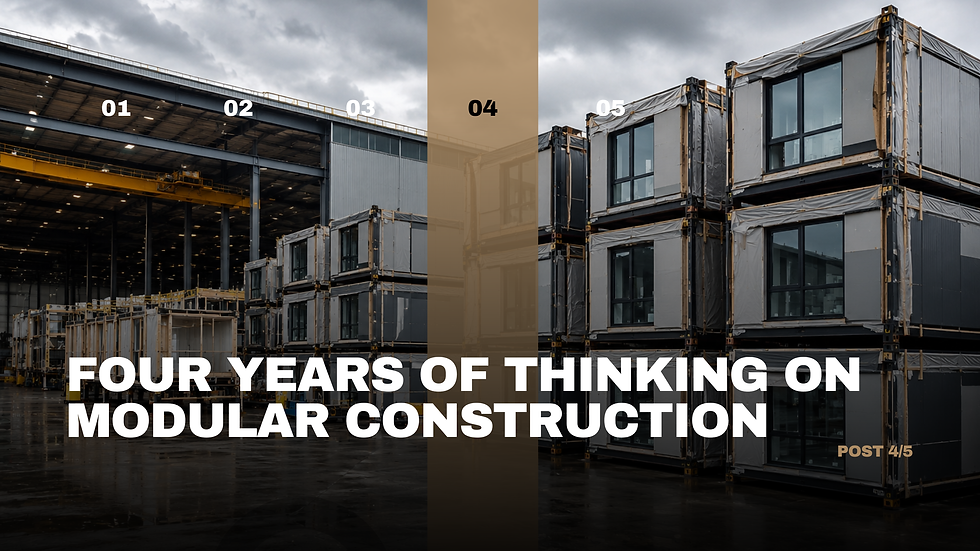
There is a particular frustration in being ahead of the mainstream. The modular and prefabricated construction industry understands this well. The case for it is clear: faster delivery, less waste, better quality control, fewer workers needed on-site, real life-cycle cost advantages, and a supply chain that can be made genuinely resilient. The barrier is not evidence. The barrier is that the existing system was not built for it.
Procurement contracts, zoning rules, financing models, and trades labour agreements were all designed around site-built construction, the traditional method where everything happens on location, sequentially. A logistics-first approach, where components are precision-designed, built simultaneously in distributed facilities, and assembled on-site from a coordinated kit of parts also does not fit neatly into those structures. The people who administer those structures are not incentivised to adapt them. This is not malice. It is institutional gravity.
But the larger forces are now aligned in ways they were not five years ago. Canada faces a housing shortfall estimated at 3.5 million units by 2030, a scale that conventional construction simply cannot address at the required pace. Skilled trades workers are retiring faster than they are being replaced. Carbon reduction targets for buildings are tightening. And the ability to deliver housing without dependence on fragile international supply chains is now a national policy priority in a way it simply was not before 2020.
The thesis does not need to change. The mainstream is moving toward it.
What Comes Next
Fifty-five years of environmental consciousness did not arrive at a destination. It arrived at a more honest map.
We can see more clearly now… the problems, the scale, the complexity, and yes, the gap between what institutions have claimed and what the numbers actually show. That clarity is not comfortable. But it is the foundation on which the next phase of the built environment will be constructed, literally and figuratively.
There is a principle in systems thinking sometimes called the butterfly effect, the idea that a small, precise action at the right moment, in the right place, can set the trajectory of something far larger. The patient groundwork being done now, the proof-of-concept projects, the documented methodologies, the financing models being tested in real conditions, is that kind of work. It does not make headlines during the wash cycle. It determines where things go when the cycle turns.
Every word on this list; Recycle, Sustainable, Stewardship, LEED, WELL…was once the language of outliers. Then it became the language of the mainstream. The next word is being written now, in the gap between what the lobby groups claim and what the real numbers say, in the distance between a housing crisis and the delivery systems capable of actually solving it.
The mainstream always learns the word eventually.
The question is whether you are positioned, and documented,…when they do.
— John Profitt, B.Sc. P.Eng. GSC. LEED AP® | Principal, Nextlevel Modular Inc.
About This Series
This blog series explores the intersection of modular construction, sustainability, and long-term systems thinking from the perspective of practitioners who have been working at the edge of the mainstream for over two decades. Nextlevel Modular Inc. is a Vancouver-based consultancy specialising in modular, prefabricated, and logistics-first residential construction.
Prepared with AI assistance. Technical content, professional judgments, theories and premises are those of the author.


Comments