

Logistics First: The Model That Changes Everything

Four Years of Thinking on Modular Construction — Post 5 of 5
Four years. Five symposium presentations. One destination.
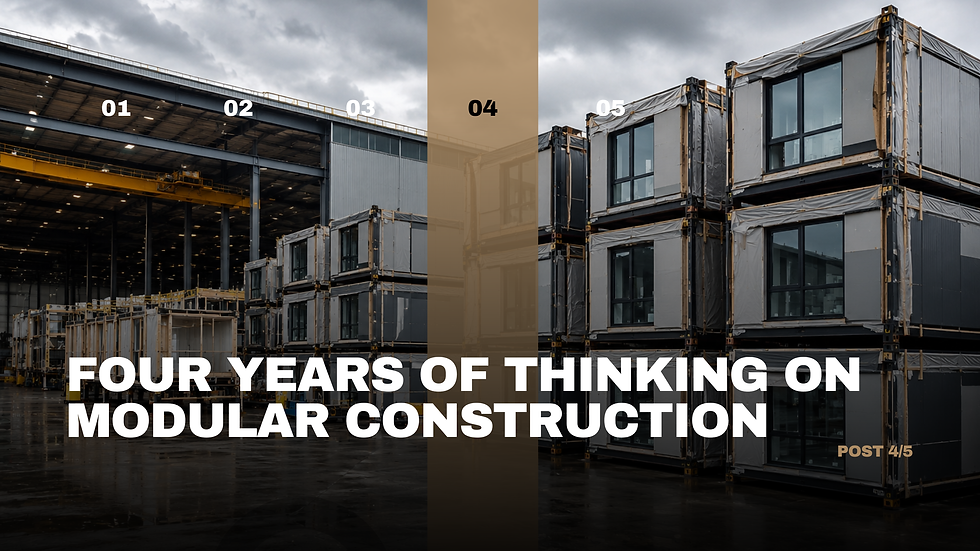
This series began with a provocation: construction isn’t failing because it’s inefficient. It’s failing because of the system it’s built on. Post 1 counted what the industry wasn’t counting. Post 2 argued the circular economy isn’t a trend — it’s the operating framework the industry needs to adopt. Post 3 named the supply chain as the smoking gun hiding in plain sight. Post 4 made the case that volumetric modular didn’t fail — it was positioned as the universal answer to a question it could only partially answer.
Now, we have the answer...
The Shift That Changes Everything
The central argument is this: when logistics is designed in from day one — not managed as a downstream problem after the fact — everything changes. Cost. Schedule. Emissions. Site complexity. Labour requirements. All of it.
That single shift in thinking is what we call the Logistics First model.
It is not a new technology. It is not a proprietary material system. It does not require a $40–120 million factory investment. It is a delivery architecture — a way of sequencing design, fabrication, and assembly so that the site becomes what it was always meant to be: a final assembly point, not a fabrication zone.
The industries that figured this out decades ago — Toyota, Airbus, shipbuilding — did not build bigger factories. They redesigned the relationship between design precision, distributed fabrication, and coordinated delivery. The result was not incremental improvement. It was a structural shift in how complex products are brought to completion. Construction is next.
The Three Streams
The Logistics First model operates through three coordinated streams. What makes it powerful is not the streams themselves — it is the fact that two of them run simultaneously, triggered by a single event: the Design Freeze. Further explanation below.

Stream 1 — Digital and Distribution
Everything begins here. Design development proceeds at LOD/LOI precision — BIM, Revit, AutoCAD — with all disciplines coordinated and clash-free. Then comes the Design Freeze: scope locked, no further changes, the coordinated digital package ready for issue.
The Design Freeze is the trigger for everything that follows. The frozen digital package is distributed simultaneously to specialist fabricators — concrete, steel, SIP panels, glazing, MEP pods, interior panels, and others specific to the project. No mega-factory. A distributed network of specialists, each working from the same coordinated set of information.
Stream 2 — Factory and Site (Simultaneous)
This is where the model earns its power. The moment the digital package is distributed, two sub-streams activate simultaneously.
The Factory Stream: specialist fabricators build components to specification — structural, envelope, MEP interfaces and building services fully coordinated at every fabricator to align precisely at assembly. Components that arrive complete because they were designed to arrive complete.
The Site Stream: at exactly the same time, the site is being prepared. Set point confirmed. Permits obtained. Utilities connected. Foundations complete. Infrastructure ready. The site stream and the factory stream run concurrently — neither waits for the other. Both conclude at the same moment: the Go Signal.
Stream 3 — Logistics (Just in Time) and Assembly
The Go Signal activates Stream 3. The Just-in-Time delivery sequence initiates — components are released to site in the sequence they will be assembled. The site receives what it needs, when it needs it, in the order it needs it.
On-site assembly proceeds from a coordinated kit of parts. Minimal site labour. Minimal waste. The site is an assembly point — not a construction zone. Assembly concludes. The building is complete, permit-ready, fully integrated.
What the Numbers Say
McKinsey’s 2019 analysis of modular construction confirms the range. The Logistics First model operates at the better end of those ranges because it addresses the root cause — not just the delivery method.
10–20% — Total project cost savings when logistics is designed in from day one
20–50% — Schedule compression through parallel factory and site streams running simultaneously
40–60% — Fewer truck trips and up to 70% lower on-site emissions
50–80% — Waste reduction compared to conventional modular factory models
These are not the numbers of a marginal improvement. They are the numbers of a structural shift.
Why This Model Works at Any Scale
The volumetric model required scale to justify its economics. Large factories. High utilisation rates. Continuous project pipelines. When the pipeline slowed, the economics collapsed. The Logistics First model has no such dependency.
It works on a single residential or commercial project. It works on a multi-unit development. It works in a remote community. It works in a dense urban infill site. The distributed fabrication network adapts to local supply chains. The model scales down as readily as it scales up — because it was never dependent on factory volume in the first place.
The Name and the Claim
We are calling it Logistics First. It is a named model, developed and applied by Nextlevel Modular Inc., and we are sharing it openly because the industry needs to start talking about it. Not because Nextlevel loses by sharing it — but because the problem is urgent enough that education matters more than exclusivity right now.
The environment cannot wait for the industry to rediscover what Toyota figured out in the 1950s.
Nextlevel’s position is straightforward: we do not win by hoarding the concept. We win by being the team that understands it most deeply, applies it most precisely, and delivers it most effectively. Any contractor can read about lean manufacturing. Few can execute it. The same will be true here.
If you are an architect, developer, or project owner who is looking at the housing crisis, the insurance market hardening against combustible construction, and the cost escalation in conventional delivery — and you are wondering whether there is a better way — there is. This is it.
— John Profitt, B.Sc. P.Eng. GSC. LEED AP® | Principal, Nextlevel Modular Inc.

Comments